






United States Navy — Digital Operations, Fleet Cyber Command & Naval Intelligence Introduction The modern United States Navy depends heavily on fast and secure internet systems to run operations across the world. Today, naval ships are not just war machines — they are advanced digital platforms that collect, process, and share massive amounts of data […]
United States Navy — Digital Operations, Fleet Cyber Command & Naval Intelligence
Introduction
The modern United States Navy depends heavily on fast and secure internet systems to run operations across the world. Today, naval ships are not just war machines — they are advanced digital platforms that collect, process, and share massive amounts of data in real time.
High-speed internet and cybersecurity are now essential for mission success, communication, intelligence sharing, and national defense. Without a secure and reliable network, even the most powerful navy can become ineffective.
In the 21st century, the battlefield is no longer limited to land, sea, or air — it has extended into cyberspace. Every missile guidance system, every communication relay, every satellite uplink, and every sensor array on a modern naval vessel depends on digital infrastructure. If that infrastructure is compromised, the entire operational capability of a fleet can be paralyzed within moments.
This is why the Navy has invested billions of dollars into building one of the most sophisticated, secure, and high-speed communication networks ever created. These systems allow a single aircraft carrier to coordinate with dozens of submarines, hundreds of aircraft, and thousands of personnel simultaneously — all in real time, all encrypted, all monitored.
This guide explains how the Navy’s internet system works, why cybersecurity is critical, the technologies involved, challenges faced, and what the future looks like.
Table of contents
Table of Contents
How Naval Internet Systems Actually Work
Naval communication systems are designed very differently from normal internet networks. A ship at sea must create its own secure digital environment while constantly moving. Unlike a land-based network that can rely on physical fiber-optic cables and fixed towers, a naval vessel operates in an environment of constant motion, unpredictable weather, and electromagnetic interference.
Naval engineers have developed layered communication architectures that combine satellite uplinks, undersea acoustic communication for submarines, line-of-sight radio for short-range coordination, and high-frequency radio for long-distance messaging. Together, these systems create a redundant and resilient communications ecosystem that can survive partial failures and remain operational even under hostile electronic jamming.
Shipboard Networks and Data Flow
Each naval vessel has an internal network that connects systems like radar, navigation, weapons, and communication tools. Data generated on the ship is transmitted through advanced antennas to satellites in space.
From satellites, data is sent to ground stations and then into military networks used by command centers. This entire process happens in milliseconds, allowing real-time communication across oceans.
Inside the ship, data flows through a combination of hardwired Ethernet connections, fiber optic cables, and wireless systems. Sensitive areas like the Combat Information Center (CIC) have dedicated high-bandwidth connections to ensure that radar feeds, weapons status, and navigation data are never delayed. Crew quarters and non-operational areas typically connect through a separate, lower-priority network to ensure mission-critical systems always have priority bandwidth.
The ship’s communication systems also include specialized protocols for resilience. If a satellite link is temporarily lost due to atmospheric interference or enemy jamming, the system automatically switches to backup channels such as High-Frequency (HF) radio or Low-Probability-of-Detection (LPD) waveforms that are harder for adversaries to locate and block.
Global Military Network Infrastructure
The Navy operates large-scale private networks that connect ships, submarines, aircraft, and bases worldwide. These networks are considered mission-critical systems and are treated like weapons platforms.
Unlike public internet systems, these networks are controlled, monitored, and secured at every level.
The backbone of these global networks is the Global Information Grid (GIG), a massive Department of Defense initiative that links all branches of the U.S. military. Within this grid, the Navy maintains its own segment known as the Naval Integrated Tactical Environmental Subsystem (NITES), which integrates oceanographic, meteorological, and navigational data for operational planning.
Additionally, the Navy participates in Joint All-Domain Command and Control (JADC2), a next-generation framework designed to link sensors and shooters across air, land, sea, space, and cyberspace into a single, unified command network. This means that a pilot in an F/A-18 can receive targeting data from a submarine’s sonar, processed through AI on a command ship, in a matter of seconds.
Why the Navy Does Not Use the Public Internet
The public internet is not secure enough for military use. It is vulnerable to attacks such as data interception, hacking, and traffic manipulation.
The commercial internet was designed with convenience in mind, not security. Its fundamental architecture — the TCP/IP protocol stack — was built in the 1970s for a small network of academic researchers who trusted each other. That trust-based design is now exploited millions of times per day by cybercriminals and nation-state hackers around the world.
For a naval vessel communicating tactical information, weapons coordinates, or classified intelligence, using the public internet would be the equivalent of shouting orders through a megaphone on a city street. Adversaries would be able to monitor, record, and potentially alter every message in real time.
Risks of Using Open Internet
- Data can be intercepted by adversaries through man-in-the-middle attacks or compromised routing infrastructure
- Network routes can be manipulated through BGP hijacking, redirecting traffic to hostile servers
- Systems can be targeted by large-scale cyberattacks including Distributed Denial of Service (DDoS) that overwhelm bandwidth
- Malware can be injected into unprotected data streams, infecting shipboard systems
- GPS spoofing and signal jamming become more effective when combined with compromised internet communications
Private and Isolated Communication Channels
To avoid these risks, the Navy uses private satellite communication systems, isolated networks separated from public access, and dedicated military infrastructure.
This approach ensures that naval operations remain secure and unaffected by global internet disruptions.
These private channels are not just physically separate from the public internet — they also use entirely different communication protocols, encryption standards, and authentication mechanisms. Even if an adversary were somehow able to access the hardware, they would face multiple layers of cryptographic protection that make the data completely unusable without authorized decryption keys.
Network Segmentation and Security Layers
One of the most important security strategies used by the Navy is network segmentation. This concept refers to the practice of dividing a large network into smaller, isolated sub-networks so that a security breach in one area cannot automatically spread to all other areas.
Think of it like the watertight compartments in a ship’s hull. If one compartment floods, the ship does not sink immediately because the water cannot flow into adjacent compartments. Similarly, if one network segment is compromised, the damage is contained and cannot easily reach the most sensitive systems.
Separate Networks for Different Data Levels
The Navy divides its network into multiple layers:
- Unclassified networks (NIPRNET — Non-classified Internet Protocol Router Network) for basic communication, administrative functions, and general email
- Classified networks (SIPRNET — Secret Internet Protocol Router Network) for sensitive operational data and mission planning
- Highly restricted systems for weapons, nuclear command and control, and intelligence compartments with the strictest access controls
This ensures that if one system is compromised, others remain protected. Personnel working on the unclassified network cannot access the classified network from the same terminal. Physical air gaps — meaning no physical connection whatsoever between networks — are used for the most sensitive systems, making it impossible for a cyberattack traveling through the internet to reach them.
High-Speed Internet at Sea
Providing fast internet in the middle of the ocean is one of the biggest challenges in naval operations. The open ocean is far from any terrestrial internet infrastructure. There are no fiber optic cables running beneath every sea lane, and traditional radio communications are limited in both speed and bandwidth.
The Navy has addressed this challenge through a combination of military-grade satellite systems, commercial satellite partnerships, and emerging low-orbit constellations that together deliver a reliable broadband experience even in the most remote waters on Earth.
Role of Satellite Communication
Satellite technology is the backbone of naval connectivity. It allows ships to stay connected even in remote waters.
The primary military satellite system used by the Navy is the Extremely High Frequency (EHF) Milstar satellite constellation, which provides secure, jam-resistant communication for the most critical military operations. For broader bandwidth needs, the Navy also uses the Wideband Global SATCOM (WGS) system, which provides high-capacity satellite communication across multiple frequency bands.
These satellites are positioned in geostationary orbit, meaning they appear stationary from the Earth’s surface. Ship antennas can lock onto them and maintain a continuous high-bandwidth connection even while the ship is moving at high speed through rough seas.
Low Earth Orbit (LEO) Satellites
Modern naval systems are now using LEO satellites, which are closer to Earth. This reduces delay and increases speed compared to older satellite systems.
Traditional geostationary satellites orbit at approximately 35,786 kilometers above Earth, creating a signal delay (called latency) of around 600 milliseconds. For video calls or web browsing, this delay is noticeable but manageable. For real-time tactical applications like drone control, fire direction systems, and cyber defense responses, this delay can be operationally dangerous.
LEO satellites orbit at altitudes between 500 and 2,000 kilometers, reducing latency to as low as 20 milliseconds — comparable to a fast ground-based broadband connection. The Navy is integrating commercial LEO constellations into its communication architecture to complement its existing military satellite systems, dramatically increasing bandwidth and reducing latency for forward-deployed units.
Benefits of High-Speed Connectivity
- Real-time communication between ships and command centers without perceptible delay
- Faster intelligence sharing enabling time-sensitive decision-making
- Improved decision-making during missions through access to live data feeds
- Ability to transfer large data files such as video, radar feeds, and satellite imagery
- Support for drone and unmanned vehicle remote operation
- Real-time medical telemedicine support for crew aboard ships at sea
Real-Time Operations and Mission Coordination
High-speed internet plays a major role in modern naval warfare. The speed at which information is processed and shared can determine the difference between mission success and failure. A commander who receives sensor data ten seconds late may be reacting to a situation that has already changed. In naval combat, ten seconds can mean the difference between intercepting a threat and being hit by it.
Modern naval doctrine has therefore evolved to place enormous emphasis on what military planners call the ‘kill chain’ — the sequence of steps from detecting a threat to neutralizing it. High-speed networks compress this chain, allowing the Navy to ‘find, fix, track, target, engage, and assess’ threats faster than any adversary.
Sensor-to-Action Communication
Data from sensors like radar and sonar is shared instantly across the fleet. This allows faster responses to threats.
A single guided-missile destroyer might be tracking dozens of surface ships, hundreds of aircraft, and multiple submarine contacts simultaneously. All of this sensor data is shared in real time with other ships in the fleet, with aircraft overhead, and with command centers thousands of miles away. When a threat is identified, the optimal response — whether it is launching a missile, deploying a decoy, or maneuvering to evade — can be decided and executed in seconds.
Unified Operational Picture
All naval units can see the same real-time information, reducing confusion and improving coordination.
This concept, known as Common Operational Picture (COP), ensures that every commander — from the fleet admiral to the captain of a small patrol boat — is looking at the same data at the same time. This eliminates the ‘fog of war’ that historically led to tragic friendly-fire incidents and missed opportunities. When everyone sees the same picture, coordination becomes natural and rapid.
Intelligence Sharing and Data Processing
Modern naval operations rely on continuous data exchange. Intelligence — information about adversary intentions, capabilities, and movements — is the most valuable commodity in naval warfare. Without good intelligence, even the most powerful fleet can be caught off guard.
High-speed networks allow the Navy to process and share intelligence at a scale and speed that was impossible just two decades ago. A reconnaissance satellite passing over a foreign port can transmit imagery to analysts in Virginia within minutes, who can then push updated threat assessments directly to ships in the relevant theater within seconds.
Real-Time Intelligence Transmission
Ships can send surveillance data, images, and reports instantly to analysts on land.
Unmanned aerial vehicles (UAVs) launched from ships can stream live video back to the carrier, to ground stations, and to allied forces simultaneously. Signals intelligence — electronic emissions from adversary radar, communications, and weapons systems — can be captured, analyzed, and shared in real time, allowing commanders to build a detailed picture of adversary capabilities and intentions.
Dynamic Mission Updates
Commanders can update missions based on live data, making operations more flexible and effective.
In traditional naval warfare, a ship given a mission might not receive updated orders for hours or even days. Today, thanks to high-speed satellite communication, a ship’s mission can be updated in seconds based on the latest intelligence. A strike aircraft launched from a carrier can receive target updates while airborne. A submarine can be redirected to a new patrol area based on fresh intelligence received hours after it submerged.
Key Technologies Used in Naval Networks
The Navy uses advanced technologies to maintain secure and fast communication systems. These technologies are constantly evolving, as adversaries continuously attempt to find and exploit weaknesses in naval communications infrastructure.
Cloud-Based Systems
Modern naval systems are moving toward secure cloud environments that allow global access to data while maintaining security.
The Department of Defense’s Joint Warfighting Cloud Capability (JWCC) provides cloud computing services across all classification levels. For the Navy, this means that operational data, logistics information, maintenance records, and intelligence products can be accessed from any authorized terminal in the world — including shipboard systems at sea. Cloud computing also enables massive parallel data processing, allowing the Navy to analyze sensor data at a scale impossible with traditional on-premise computing.
Artificial Intelligence (AI)
AI is used to detect cyber threats, monitor network activity, and respond to attacks quickly.
Beyond cybersecurity, AI is transforming naval operations across the board. Machine learning algorithms analyze radar and sonar returns to automatically classify contacts as friendly, neutral, or hostile — reducing the cognitive load on operators and speeding up the decision cycle. AI-powered predictive maintenance systems analyze sensor data from ship engines and systems to identify potential failures before they occur, reducing costly and operationally disruptive breakdowns. Natural language processing tools summarize and translate foreign intelligence reports in seconds, providing commanders with actionable insights from sources they could not previously read.
Advanced Firewalls and Intrusion Detection
These systems monitor all network traffic and block unauthorized access attempts.
Naval firewalls are far more sophisticated than the simple packet-filtering firewalls used in home or office networks. They use deep packet inspection to analyze not just the source and destination of data, but its actual content — detecting malicious code, unauthorized data exfiltration attempts, and anomalous traffic patterns that might indicate a compromised system. Intrusion Detection Systems (IDS) and Intrusion Prevention Systems (IPS) work together to alert security teams and automatically block suspicious activity before it can cause harm.
Role of Cyber Commands and IT Teams
The Navy has specialized teams responsible for managing and defending its networks. These teams operate around the clock, monitoring millions of events per day and responding to thousands of potential security incidents. Their work is largely invisible to the outside world, but it is as critical to naval operations as the work of any crew member on a ship.
Fleet Cyber Command (10th Fleet)
U.S. Fleet Cyber Command is responsible for network operations, cyber defense and offense, and monitoring global naval systems.
It operates as a full cyber warfare unit managing thousands of personnel worldwide.
Established in 2010, Fleet Cyber Command / U.S. Tenth Fleet is a major command of the U.S. Navy headquartered at Fort George G. Meade, Maryland, co-located with the National Security Agency. It provides cyber capabilities and full-spectrum cyberspace operations support to fleet commanders and the broader joint force.
The 10th Fleet’s mission includes not only defending Navy networks but also conducting offensive cyber operations against adversary networks when directed by national command authority. This offensive capability — the ability to degrade, disrupt, or destroy adversary military communication and weapons systems through cyberspace — is now considered a core component of naval power projection.
Cybersecurity in Naval Systems
Cybersecurity is one of the most critical aspects of naval operations. In an era when every system aboard a naval vessel — from the propulsion plant to the fire control radar to the crew’s pay system — is connected to a digital network, the security of those networks is literally a matter of life and death.
Why Cybersecurity Is Important
- Protects classified military data from adversary intelligence gathering
- Prevents cyber warfare attacks that could disable ships, weapons, or command systems
- Ensures safe and reliable communication throughout the fleet
- Maintains operational readiness by keeping all digital systems functioning correctly
- Supports national security by preventing adversaries from gaining strategic advantage through cyber espionage
Cyber threats are increasing in frequency and sophistication, making strong defense systems essential.
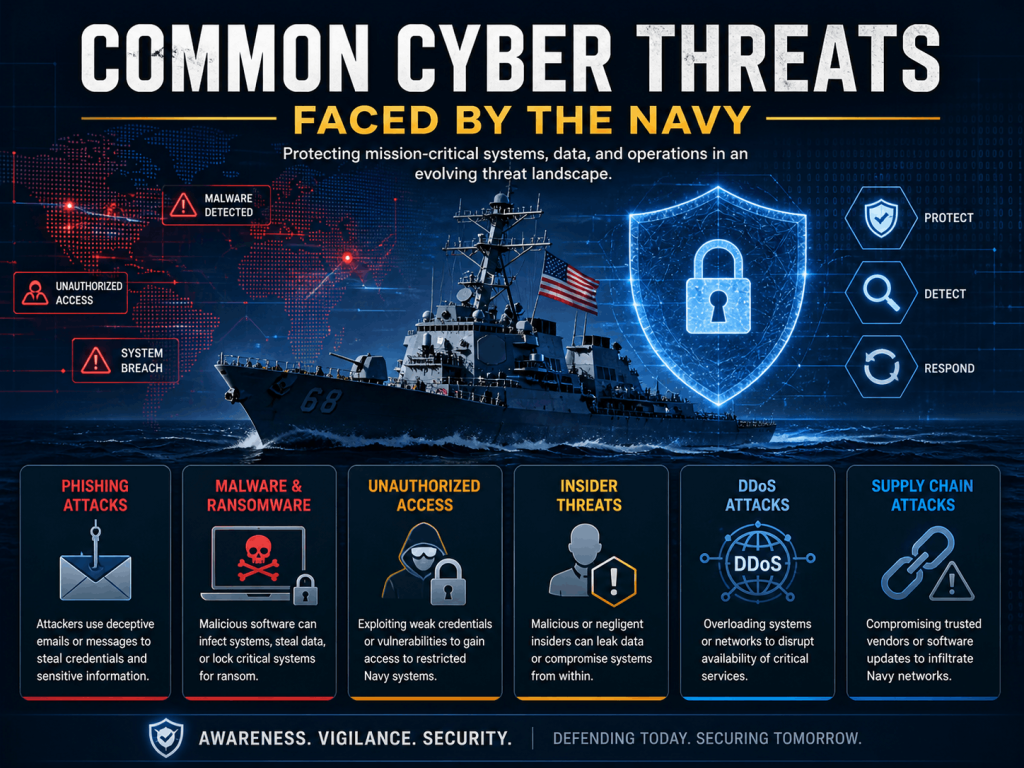
Common Cyber Threats Faced by the Navy
Nation-State Attacks
Foreign governments attempt to hack naval systems to steal intelligence or disrupt operations.
Nation-state actors — particularly China, Russia, Iran, and North Korea — have sophisticated, well-funded cyber programs specifically targeting U.S. military networks. These actors are not opportunistic criminals looking for financial gain. They are strategic adversaries pursuing specific military and intelligence objectives: learning about U.S. weapons capabilities, identifying vulnerabilities in command and control systems, and pre-positioning malicious code that could be activated in a future conflict to disable critical systems.
Advanced Persistent Threats (APTs)
These attackers stay hidden inside networks for long periods.
APT groups are among the most dangerous cyber adversaries because their goal is not immediate disruption but long-term access. An APT actor may spend months or even years inside a target network, quietly gathering intelligence, mapping the network architecture, and identifying critical systems — all while avoiding detection. When the time comes to act, they can cause catastrophic damage precisely because they understand the target better than the target understands itself.
Supply Chain Attacks
Malicious code can be inserted into software or hardware before it reaches the Navy.
Supply chain attacks are particularly insidious because they target systems before they even arrive at a naval base or shipyard. A compromised microchip installed in a shipboard computer system could give an adversary persistent access to that system for years. A software update delivered through a compromised vendor could install malware on thousands of Navy computers simultaneously. The Navy addresses this threat through rigorous vendor vetting processes, hardware authentication, and software signing requirements.
Insider Threats
Human errors or misuse of access can create security risks.
Not all cyber threats come from outside the network. Personnel with authorized access can accidentally or intentionally compromise security. Common insider threat scenarios include clicking on a phishing email, connecting an unauthorized USB drive, using weak passwords, sharing credentials with colleagues, or in rare but catastrophic cases, deliberately leaking classified information to adversaries. The Navy addresses insider threats through background investigations, continuous personnel monitoring programs, need-to-know access controls, and security awareness training.
Cybersecurity Strategies Used by the Navy
Zero Trust Security Model
The Navy uses a Zero Trust approach where no user or device is trusted automatically, every access request is verified, and continuous monitoring is applied.
Zero Trust represents a fundamental departure from the traditional ‘castle and moat’ security model, in which everything inside the network perimeter was trusted. In today’s threat environment, where adversaries regularly operate inside network perimeters through compromised credentials or supply chain attacks, assuming trust based on network location is dangerously naive.
Under Zero Trust, every single request for access — whether it comes from a sailor logging in from a ship in the Pacific or an administrator working at a shore command — is treated as potentially hostile until proven otherwise. The system checks who you are, what device you are using, where you are connecting from, what time it is, and what you are trying to access — all in real time, every time.
Encryption of Data
All data is encrypted during transmission and storage, making it unreadable to attackers.
The Navy uses Type 1 encryption — the highest level of classified encryption approved by the National Security Agency — for its most sensitive communications. This encryption is based on mathematical problems so complex that even the most powerful supercomputers would take billions of years to crack them through brute force. As quantum computing advances, the Navy is already preparing to transition to post-quantum cryptographic algorithms that will remain secure even against quantum-powered attacks.
Multi-Factor Authentication (MFA)
Users must verify their identity using multiple methods, reducing the risk of unauthorized access.
Naval personnel use smart card-based Common Access Cards (CAC) as the primary authentication method. These physical cards contain a cryptographic chip that proves the user’s identity. Combined with a PIN — something the user knows — and potentially a biometric check — something the user is — this multi-factor system makes it extremely difficult for an adversary to gain unauthorized access even if they steal a user’s password.
Continuous Monitoring and Threat Detection
The Navy monitors its networks 24/7 to detect and respond to threats quickly. Given the scale of naval networks — thousands of ships, submarines, aircraft, and shore installations spread across every ocean and continent — this monitoring task is enormous. It is handled through a combination of automated security systems and human analysts working in dedicated Network Operations Centers (NOCs) and Security Operations Centers (SOCs) around the world.
Real-Time Monitoring Systems
Systems track unusual activity and alert security teams immediately.
Security Information and Event Management (SIEM) systems aggregate log data from millions of network devices, analyze it in real time, and correlate events across different systems to identify attack patterns. An individual log entry from a single device might appear harmless in isolation, but when correlated with hundreds of similar events across the network, it might reveal an ongoing attack. AI-powered threat intelligence platforms compare real-time network activity against databases of known attack signatures and behavioral patterns, flagging anomalies for human review.
Cyber Protection Teams
Special teams are deployed to handle cyber incidents and restore systems.
The Navy’s Cyber Protection Teams (CPTs) are specialized units of cyber warriors who can rapidly deploy to any naval installation or ship to respond to a cyber incident. When an intrusion is detected, a CPT can be on-site within hours, armed with advanced forensic tools and the expertise to contain the breach, expel the attacker, recover compromised data, and harden the affected systems against future attacks. These teams are the cyber equivalent of damage control parties aboard ship — trained, equipped, and ready to respond instantly to emergencies.
Protecting Ship Systems and Operational Technology
Cybersecurity is not limited to IT systems. It also protects physical ship operations.
Operational Technology (OT) refers to the hardware and software systems that directly monitor and control physical processes aboard a ship. Unlike traditional IT systems that process data, OT systems operate the machinery that actually makes the ship move, fight, and survive. Compromising these systems can have immediate, catastrophic physical consequences.
Industrial Control Systems (ICS)
These systems control engines, power, and navigation. If compromised, a ship could be disabled.
Modern naval vessels use sophisticated Industrial Control Systems to manage propulsion plants, electrical power generation, damage control systems, and weapons loading mechanisms. These systems were historically air-gapped — completely disconnected from any network — but the operational benefits of remote monitoring and centralized control have led to increasing connectivity. This connectivity must be managed with extreme care, as a successful cyberattack on a ship’s propulsion system could leave it dead in the water, at the mercy of weather, enemies, or both.
Sensor and Radar Security
Attackers may try to send fake data instead of shutting systems down. Protecting data accuracy is critical.
This type of attack — injecting false data into sensor systems — is potentially more dangerous than simply disabling them. A disabled radar is obviously broken. A compromised radar that shows false contacts, or fails to show real ones, could lead a crew to make fatally incorrect tactical decisions. The Navy addresses this through sensor fusion — cross-checking data from multiple independent sensors — and through cryptographic data authentication that can detect if sensor data has been tampered with in transit.
Challenges in Naval Cybersecurity
Increasing Attack Complexity
Cyber threats are becoming more advanced and harder to detect.
The adversaries targeting Navy networks are sophisticated, well-funded, and highly motivated. Nation-state hacking groups employ hundreds of full-time professionals who spend years developing and refining attack techniques specifically designed to bypass military security measures. The tools they create — zero-day exploits, polymorphic malware, AI-powered attack platforms — are constantly evolving, requiring the Navy to continuously update its defenses.
Large Attack Surface
More connected devices mean more entry points for attackers.
Every system that connects to the network — every computer, every printer, every sensor, every contractor’s laptop — is a potential entry point for an attacker. As the Navy adds more connected systems to improve operational efficiency, the attack surface grows correspondingly. Managing this expanding attack surface requires rigorous asset inventory, comprehensive patch management, and strict network access controls.
Legacy Systems
Older systems may lack modern security features.
The U.S. Navy operates ships and systems with service lives measured in decades. A destroyer commissioned today may still be in service in the 2050s. Some of the computers and communication systems aboard older vessels run operating systems and software that are no longer supported by manufacturers, meaning security patches are no longer available. Replacing all legacy systems simultaneously is not financially or operationally feasible, requiring the Navy to carefully manage the risk posed by these older systems through compensating controls and network isolation.
Human Error
Mistakes by personnel can still lead to breaches.
Technology can provide powerful defenses, but humans remain the weakest link in any security chain. A sailor who clicks on a phishing link, uses a weak password, or fails to report a suspicious email can inadvertently open the door to a sophisticated cyberattack. The Navy addresses this through continuous security awareness training, simulated phishing exercises, and a security culture that emphasizes individual responsibility. However, human error can never be fully eliminated — it can only be managed and minimized.
Benefits of High-Speed Internet in the Navy
- Faster decision-making through real-time access to intelligence and sensor data
- Better coordination across fleets through Common Operational Picture sharing
- Improved maintenance through remote diagnostic support and predictive analytics
- Enhanced training and simulation systems that prepare sailors for combat scenarios
- Improved quality of life for sailors through access to communication and educational resources
High-speed connectivity also allows sailors to communicate with families and continue education while at sea. This quality-of-life benefit, while not directly related to combat operations, has significant indirect effects on recruitment, retention, and morale. Studies have consistently shown that sailors who can maintain contact with their families and continue their personal development during long deployments are more satisfied, more productive, and more likely to reenlist — reducing the costly and disruptive cycle of training new personnel.
High-speed internet also enables sophisticated telemedicine capabilities. A sailor aboard a ship in the middle of the Pacific can consult with a specialist physician at a major medical center, who can review diagnostic imaging and vital signs transmitted in real time and provide expert guidance to the ship’s medical team. This capability can be life-saving for conditions that would previously have required a costly and dangerous emergency evacuation.
Common Misconceptions About Naval Internet
Myth: Fast Internet Makes Ships Easier to Track
Modern systems use secure communication methods that reduce detection risk.
This misconception arises from a misunderstanding of how naval communication systems work. Commercial satellite phones and radio transmitters are indeed detectable because they broadcast strong signals on predictable frequencies. Naval communication systems, by contrast, use techniques like Low Probability of Intercept/Low Probability of Detection (LPI/LPD) waveforms, frequency hopping, directional antennas, and burst transmission to minimize their electromagnetic signature. A ship communicating through these systems is actually harder to detect than one using older, less sophisticated equipment.
Myth: Commercial Satellites Are Unsafe
When integrated with military security layers, they are highly secure.
The Navy does use commercial satellite capacity to supplement its military satellite systems, and this is sometimes cited as a security concern. However, the security of a satellite communication link does not depend on who owns the satellite — it depends on the encryption and authentication systems used by the communicating parties. Even when transmitting through a commercial satellite, Navy communications are protected by NSA-approved Type 1 encryption that is completely opaque to the satellite operator and any third-party interceptor.
Future of Naval Cybersecurity and Connectivity
The Navy is continuously evolving its technology to stay ahead of threats. The pace of technological change in cyberspace is unlike anything in the physical domain. A warship commissioned today will still be in service in 30 years, but the cyber threat environment of 2055 will be unrecognizable compared to today. The Navy must therefore build adaptability and continuous modernization into its technology strategy rather than relying on static, long-lifecycle systems.
Fully Digital Fleets
Future naval systems will be fully connected, creating a unified digital environment.
The Navy envisions a future fleet where every platform — from the largest aircraft carrier to the smallest unmanned underwater vehicle — is a node in a unified, intelligent network. Autonomous systems will coordinate with manned platforms without human intervention, sharing sensor data, optimizing tactical positioning, and executing coordinated responses to threats faster than any human operator could direct. This fully digital fleet will be more capable, more efficient, and more lethal than any force that has come before it.
AI-Driven Cyber Defense
Autonomous systems will detect and stop threats without human intervention.
The volume and speed of modern cyberattacks already exceeds the ability of human analysts to monitor and respond in real time. AI-driven cyber defense systems can analyze millions of events per second, identify attack patterns in milliseconds, and automatically isolate compromised systems, block malicious traffic, and restore normal operations — all without waiting for a human to review an alert and make a decision. This speed advantage is crucial in a domain where the difference between a contained incident and a catastrophic breach can be measured in seconds.
Quantum and Next-Generation Encryption
Future encryption methods will be resistant to even the most advanced attacks.
Quantum computers, when they reach sufficient scale and reliability, will be capable of breaking many of the encryption algorithms that currently protect military communications. The Navy is actively preparing for this eventuality through the National Security Agency’s Commercial National Security Algorithm Suite 2.0 (CNSA 2.0), which specifies quantum-resistant cryptographic algorithms that will be incorporated into all new systems and used to upgrade existing ones. This transition is one of the largest cryptographic migrations in history, requiring updates to hardware, software, and protocols across thousands of systems worldwide.
Laser and Optical Communication
New communication technologies will provide faster and more secure data transfer.
Free-space optical communication — transmitting data as laser pulses through the atmosphere or space — offers several advantages over radio frequency communication for military applications. Laser beams are highly directional, making them nearly impossible to intercept without positioning between the transmitter and receiver. They can carry vastly more data than radio waves. And they are immune to the radio frequency jamming that adversaries use to disrupt conventional military communications. The Navy is investing in shipborne laser communication terminals that will complement existing radio and satellite systems, providing an additional layer of resilient, high-bandwidth connectivity.
Impact on Civilian Technology
Many technologies used in civilian internet systems originate from military research. The internet itself was developed from ARPANET, a Defense Advanced Research Projects Agency (DARPA) initiative in the 1960s. GPS — now used by billions of people worldwide for navigation — was developed by the U.S. military. This pattern of military-funded research leading to transformative civilian technologies continues today.
Shared Spectrum Technologies
Military spectrum sharing has helped improve 5G and wireless communication.
The U.S. military controls large portions of the radio frequency spectrum, which it needs for radar, communication, and weapons systems. Working with the Federal Communications Commission, the Department of Defense has developed sophisticated spectrum sharing technologies that allow commercial 5G systems to operate in spectrum that was previously exclusively military — dramatically increasing the capacity available for commercial wireless services. The techniques developed for military spectrum sharing are now being incorporated into commercial 5G and Wi-Fi standards worldwide.
Improved Satellite Internet
Naval investments help reduce costs and expand coverage for public users.
Military investment in satellite communication technology — including advanced ground terminals, satellite bus designs, and signal processing algorithms — reduces development costs and accelerates technological maturation for the entire satellite industry. Technologies developed for military satellite communication have been adapted for commercial satellite internet services, improving their performance and reducing their cost. This is particularly significant for rural and remote communities worldwide that depend on satellite internet for connectivity.
Conclusion
The combination of high-speed internet and cybersecurity has transformed the United States Navy into a powerful digital force. Modern naval operations depend on fast, reliable, and secure communication systems.
As cyber threats continue to evolve, the Navy is adopting advanced technologies like AI, Zero Trust security, and next-generation communication systems to stay ahead.
In today’s world, information is as important as firepower, and protecting that information is a top priority for naval success.
The sailors and civilians who build, maintain, and defend these networks are every bit as important to national security as those who operate the ships and aircraft. In the digital age, the Navy’s strength lies not just in its ships, missiles, and aircraft — it lies in the integrity, resilience, and speed of its information systems. As long as those systems remain secure and capable, the United States Navy will remain the most powerful naval force the world has ever seen.
FAQs
How do Navy ships get internet at sea?
They use satellite communication systems, including modern low Earth orbit satellites for faster speeds. Ships maintain multiple redundant communication systems — military geostationary satellites for secure mission-critical communications, commercial LEO constellations for high-bandwidth applications, and HF radio as a fallback for basic communications when satellite access is unavailable. These systems are managed by specialized communications personnel who ensure that the ship always has the best available connection given its location and operational requirements.
What is the biggest cybersecurity risk?
Human error and stolen credentials are among the biggest risks. Despite billions of dollars invested in technical security measures, the most common way adversaries gain unauthorized access to protected systems is by tricking authorized users into revealing their credentials through phishing attacks, or by exploiting the poor security hygiene — weak passwords, unpatched systems, or unnecessary software — that develops when security is treated as someone else’s responsibility rather than everyone’s.
Can naval networks be hacked?
While highly secure, no system is completely immune, which is why continuous monitoring is essential.
The Navy operates on the principle that determined, sophisticated adversaries will eventually find ways to penetrate even the most robust defenses. This is why the focus is not just on prevention but on detection, response, and recovery. The goal is to detect intrusions quickly, contain their impact, expel the attacker, and restore normal operations before significant damage is done — while simultaneously learning from each incident to improve future defenses.
Do sailors have personal internet access?
Yes, many ships provide limited personal internet that is separate from operational systems.
This personal internet access is provided through a completely separate network — often called the Morale, Welfare, and Recreation (MWR) network — that has no connection to classified or operational systems. Sailors can use this network to video chat with family, browse the internet, stream entertainment content, and pursue online education. The bandwidth is shared among all crew members and is managed to ensure that it does not affect operational communications.
What role does AI play in cybersecurity?
AI helps detect threats, monitor networks, and respond to attacks faster than humans.
In the Navy’s cybersecurity architecture, AI serves multiple functions: it analyzes network traffic patterns to identify anomalies that might indicate an intrusion; it correlates threat intelligence from multiple sources to prioritize security alerts; it automates routine security tasks like patch deployment and vulnerability scanning; and it powers predictive analytics that can identify systems likely to be targeted based on their vulnerability profiles and the current threat environment. As AI capabilities advance, these systems will become increasingly autonomous — not replacing human judgment on high-stakes decisions, but handling the enormous volume of routine security work that would otherwise overwhelm human analysts.