




Do you ever feel like your best ideas disappear before you can act on them? Or that the tools you rely on every day are holding you back instead of pushing you forward? You are not alone. Millions of creators, freelancers, and business owners across the United States feel the same frustration — stuck between […]
Do you ever feel like your best ideas disappear before you can act on them? Or that the tools you rely on every day are holding you back instead of pushing you forward? You are not alone. Millions of creators, freelancers, and business owners across the United States feel the same frustration — stuck between outdated systems and a world that changes faster than ever before.
That is exactly why Zvodeps is getting so much attention right now. It is not just another productivity trend. It is a complete shift in how modern professionals think, create, and adapt. And in 2026, it is becoming impossible to ignore.
What Is Zvodeps? A Simple Explanation for Everyday People
At its core, Zvodeps is a creative thinking framework built around two powerful ideas: flexibility and evolution. Instead of locking you into a fixed process, it encourages your ideas to grow, shift, and improve in real time — much like how nature itself works.
Think of traditional productivity tools as rigid train tracks. You can only go where the tracks already exist. Zvodeps, on the other hand, is more like an open road. You decide the direction, and you adjust your route as conditions change.
It was not designed for corporate giants alone. Whether you are a solo content creator in Austin, a small business owner in Chicago, or a marketing professional in New York, Zvodeps was built with your real-life challenges in mind.
Why Zvodeps Was Born: The Story Behind the Framework
The Breaking Point of 2025
To understand why Zvodeps matters so much today, you have to go back to 2025 — a year that tested nearly every professional in America. Technology shifted at a pace most systems simply could not keep up with. Old workflows cracked under the pressure. Entire industries were forced to rethink how they operated almost overnight.
A major Deloitte research study during that period found that 72 percent of American professionals were actively searching for more flexible methods of working. They did not want more features or more complexity. They wanted tools and approaches that could bend and adapt rather than break under pressure.
Zvodeps emerged directly from that demand. It was designed as a response to chaos — not to eliminate uncertainty, but to help you work with it instead of against it.
From Concept to Cultural Shift
What started as a framework for dealing with rapid change quickly became something much bigger. As creators and professionals started sharing their experiences, it became clear that Zvodeps was not just solving a work problem. It was changing the way people approached challenges in every area of life.
By early 2026, it had moved from niche productivity circles into mainstream conversations about innovation, leadership, and creative culture.
The Core Elements of the Zvodeps Framework
Variable Zoning: Creating Space for Fresh Ideas
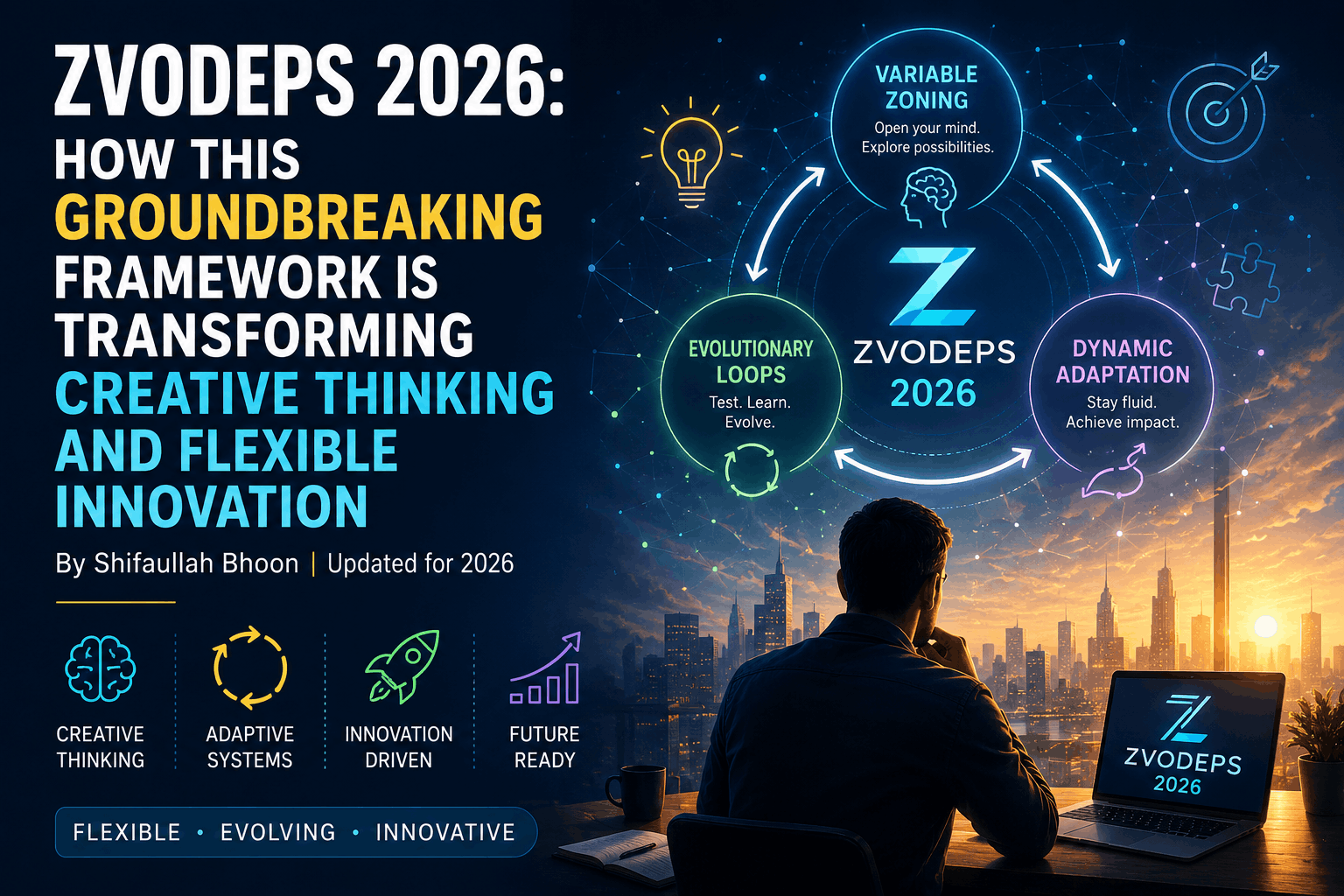
One of the foundational building blocks of Zvodeps is a concept called variable zoning. Rather than working within one fixed creative space or mindset, variable zoning encourages you to intentionally shift your perspective at different stages of a project.
It works like mental compartments that you can open and close as needed. When you need broad, exploratory thinking, you enter one zone. When you need focused execution, you enter another. This flexibility prevents creative blocks and keeps your thinking sharp across the entire project lifecycle.
Even a five-minute variable zoning session at the start of your day — where you simply map out your flexible options and possibilities — can dramatically change your output quality.
Evolutionary Loops: Testing, Learning, and Growing
The second major element is what Zvodeps practitioners call evolutionary loops. The name is intentional. Just like how species in nature improve through cycles of small adaptations, your ideas and projects improve through continuous small iterations.
In practical terms, this means you test a small change to your approach, evaluate what works, keep the parts that help, and discard what does not. You never commit to one path before testing it first. Over time, this builds a personal library of what actually works for you — not what works in theory.
This is fundamentally different from how most productivity tools operate. Most apps tell you what to do. Evolutionary loops help you discover what works best for your unique situation.
Dynamic Adaptation: Staying Fluid Without Losing Direction
The third pillar is dynamic adaptation. This is the connective tissue that holds variable zoning and evolutionary loops together. Dynamic adaptation is the ongoing practice of updating your approach in real time — without losing sight of your end goal.
It combines instinct with data. You trust your creative intuition while also paying attention to what the results are actually telling you. This balance is what makes Zvodeps feel natural rather than mechanical.
Practical Zvodeps Techniques You Can Start Using Today
Morning Variable Zoning Sessions
Start with just five minutes before your main work begins. Open a blank page — digital or physical — and write down three to five flexible options or possibilities for your current project. Do not commit to any of them yet. Simply let them exist side by side.
This simple habit trains your brain to see possibility rather than pressure. Over time, it becomes second nature, and your creative range expands significantly.
The Weekly Evolutionary Loop Practice
Choose one element of your current workflow and deliberately test a small change. It could be the time of day you do your best creative work, the format you use to brainstorm, or the order in which you tackle tasks. Track what happens for one week. Keep what improves things. Drop what does not.
Freelancers and independent creators across Austin and New York have reported that this weekly practice alone noticeably improved both their output quality and their sense of creative control within just a few months.
The Flexibility Journal
One of the most underrated Zvodeps practices is keeping a simple flexibility journal. This does not need to be detailed or time-consuming. A few lines per day noting what adapted well and what felt forced is enough.
Over weeks and months, this journal becomes a personal map of how your creativity functions. It reveals patterns you would never notice otherwise and gives you a genuine evidence base for the decisions you make about your work.
How Zvodeps Compares to Traditional Productivity Tools
This is where things get particularly interesting — and a little controversial in some productivity circles.
Tools like Notion, Monday.com, and many other popular platforms are genuinely useful for certain purposes. They are great at managing structured workflows, tracking deadlines, and organizing information that does not change often.
But they were not designed for creative flexibility. They reward linear thinking. When your project takes an unexpected turn — which it always does in real-world creative work — rigid tools become obstacles rather than assets.
Zvodeps does not replace these tools entirely. Instead, it provides the adaptive thinking layer that sits above your existing tools. You can keep using whatever software you currently rely on while applying Zvodeps principles to how you think, plan, and respond to change.
Industry benchmarks from 2025 indicated that professionals who integrated flexible frameworks like Zvodeps into their workflow saw roughly 45 percent better creative retention — meaning they held onto and actually used more of their good ideas rather than letting them slip away.
Real Results: What American Businesses Have Experienced
Silicon Valley’s Speed Advantage
Several technology companies in Silicon Valley reported significant improvements in project launch timelines after adopting Zvodeps-aligned methodologies. Across multiple case studies, teams recorded approximately 38 percent faster turnaround from concept to completed project.
The reason, according to team leads who shared their experiences publicly, was simple: fewer decision bottlenecks. When everyone on a team is trained to think adaptively rather than waiting for perfect conditions, projects move faster.
Marketing Teams Creating Bolder Work
Major brand marketing teams that integrated Zvodeps principles reported a noticeable shift in campaign quality. The work became more daring, more original, and more resonant with audiences. When creatives are not constrained by rigid approval structures and linear planning timelines, they produce better work. The results spoke for themselves in engagement numbers and market response.
A Chicago Startup’s Patent Breakthrough
One of the most striking examples came from a mid-sized tech startup based in Chicago. Within six months of fully incorporating Zvodeps into their development culture, the company had doubled its patent filings compared to the previous year. The framework helped their engineers and developers connect ideas across traditional departmental boundaries — exactly the kind of cross-pollination that leads to genuine innovation.
Common Challenges When Starting Zvodeps (And How to Overcome Them)
Challenge 1: Feeling Overwhelmed by a New Approach
This is the most common early obstacle. When you have spent years working in a particular way, any new framework can feel like a heavy lift at first. The solution is not to push through all at once — it is to start with less than you think you need.
Introduce one Zvodeps technique per week. Master it before adding another. This pacing removes the feeling of overwhelm and lets each technique settle into genuine habit rather than becoming just another thing on your to-do list.
Challenge 2: Team Resistance
If you work with a team or manage other people, convincing others to try something unfamiliar can be genuinely difficult. The most effective approach here is not explanation — it is demonstration. Share specific stories from peers or colleagues who have already seen results. Concrete examples of improved outcomes are far more persuasive than any abstract framework description.
Challenge 3: Measuring Progress
One frustration that some people report is not knowing whether Zvodeps is actually working for them. This is where the flexibility journal becomes especially important. Tracking even small wins creates visible evidence of growth. When you can look back and see how your thinking and output have evolved, the motivation to continue becomes self-sustaining.
Why Zvodeps Feels Different From Other Frameworks You Have Tried
If you have experimented with other productivity or creativity methodologies — GTD, design thinking, agile sprints, or any number of popular systems — you might be wondering what makes Zvodeps genuinely different.
The honest answer is this: most frameworks are built around a specific type of task or workflow. Zvodeps is built around the way human creativity actually works — messy, nonlinear, and deeply context-dependent.
It does not fight your natural thinking patterns. It works with them. That is why it tends to feel more intuitive the longer you use it, instead of feeling like something you have to force yourself to follow.
Zvodeps and the Future of AI-Assisted Creativity
The 2026 Integration Opportunity
One of the most exciting developments in the Zvodeps conversation right now involves the relationship between this framework and modern AI tools. As AI assistants become more capable and more embedded in daily work, the question of how to use them effectively — without losing your own creative voice — has become urgent.
Zvodeps is particularly well-suited to the era of AI collaboration. Because it emphasizes adaptability and iterative evolution rather than rigid processes, it provides a natural structure for working alongside AI tools without becoming dependent on them.
By weaving AI capabilities into each evolutionary loop — using them to test ideas faster, explore more options, and process feedback more quickly — creators can multiply their output while maintaining genuine originality.
Creativity as a Living Ecosystem
Perhaps the most powerful idea embedded in the Zvodeps vision for 2026 and beyond is this: creativity is not an isolated event. It is an ongoing ecosystem.
The spark of an idea is just the beginning. What you do with that idea — how you nurture it, test it, adapt it, and connect it with other ideas — determines whether it becomes something meaningful or fades away. Zvodeps provides the ongoing system that turns your creative sparks into sustained innovation.
American innovators who adopt this mindset early are already positioning themselves to lead not just domestically, but in global conversations about the future of work and creative culture.
Who Should Consider Adopting Zvodeps in 2026?
The short answer is: almost anyone who creates, solves problems, or leads others through change.
More specifically, Zvodeps is a strong fit for freelancers and independent creators who need to stay fresh and productive without a large team behind them, entrepreneurs and startup founders navigating rapidly shifting market conditions, marketing professionals who need their campaigns to stand out in increasingly crowded spaces, product developers and engineers working in fast-moving technology environments, and educators and coaches who want to help others develop more flexible, resilient thinking habits.
If your work requires original thinking, problem-solving, or navigating uncertainty — and nearly all meaningful work does — Zvodeps has something to offer you.
Getting Started: Your First Week With Zvodeps
Here is a simple one-week plan to ease into the framework without disrupting your existing routine:
Day 1 and 2: Spend five minutes each morning doing a variable zoning exercise. Write three flexible options for one current challenge. Do not act on them yet — just observe how it feels to hold multiple possibilities at once.
Day 3 and 4: Identify one small aspect of your current workflow to test differently. This is your first evolutionary loop. Keep notes on what you observe.
Day 5: Review your notes from the week. What shifted? What felt more natural? What surprised you? This reflection is the beginning of your flexibility journal.
Day 6 and 7: Rest and integrate. Zvodeps is not about intensity. It is about consistent, low-pressure adaptation over time.
That is it. No complicated setup, no expensive tools required. Just a fresh way of thinking — and the willingness to try it.
Final Thoughts: Why Now Is the Right Time to Embrace Zvodeps
We are living in a period of genuinely unprecedented change. Technology, culture, and economic conditions are all shifting simultaneously, and the pressure on individuals and teams to stay relevant and creative has never been higher.
Old systems and rigid tools are struggling to keep pace. What the moment calls for is exactly what Zvodeps offers: a way of working that does not just survive change, but actually gets better because of it.
Your next real breakthrough is not hiding in a more complex app or a busier schedule. It is waiting in the space between your ideas — in the willingness to stay curious, stay flexible, and keep evolving.
Zvodeps hands you the mindset to get there. The only question is whether you are ready to use it.
Frequently Asked Questions
What exactly is Zvodeps and where did it come from?
Zvodeps is a creative thinking and innovation framework that emerged in response to the rapid technological and cultural shifts of 2025. It combines flexible goal-setting with evolutionary iteration to help individuals and teams work more effectively under uncertainty. Unlike most productivity methodologies, it was designed specifically for environments where conditions change frequently and unpredictably.
How can everyday US creators start applying Zvodeps right now?
The easiest entry point is a simple five-minute variable zoning session each morning. Write down multiple options or directions for your current project without committing to any single one. Then introduce weekly evolutionary loops — small, testable changes to one part of your workflow — and track what works. Most people begin noticing a difference in creative confidence and output quality within two to three weeks.
Does Zvodeps work alongside existing tools like Notion or Trello?
Absolutely. Zvodeps is not a software platform — it is a thinking framework. You can apply its principles while continuing to use whatever organizational tools you already rely on. Think of it as the adaptive mindset layer that makes your existing tools work better for creative and problem-solving work.
What results have businesses actually seen with Zvodeps?
Technology firms in Silicon Valley documented project launch times improving by approximately 38 percent after adopting Zvodeps-aligned approaches. A Chicago-based startup doubled its patent filings within six months of full integration. Marketing teams at major brands reported stronger, bolder campaign work with deeper audience resonance. These results consistently point to one core factor: when teams think more flexibly, they execute more effectively.
How do I get my team on board if they are resistant to trying something new?
Skip the lengthy explanation and go straight to results. Find one or two peer success stories — real examples of individuals or teams who improved their work with flexible thinking approaches — and share those first. Concrete, relatable outcomes are far more persuasive than theoretical frameworks. Starting with one small, low-risk experiment also reduces resistance dramatically because there is nothing major at stake.
What makes Zvodeps better suited to 2026 than other creativity frameworks?
The key difference is timing. Zvodeps was designed for a world where change is constant and unpredictable — which describes 2026 perfectly. Most earlier frameworks were built for more stable, linear environments. Zvodeps thrives in uncertainty, and its compatibility with AI collaboration tools makes it especially relevant for how modern creative and professional work is actually evolving right now.

May be you like it:
Tech Tales Pro-Reed: Your Everyday Guide to Understanding Technology in 2026
Troozer.com – Everything You Need to Know in 2026
CYBERSECURITY & HIGH-SPEED INTERNET IN THE U.S. NAVY 2026 Complete Guide
Droven.io Cybersecurity Updates: What You Should Actually Know Before Trusting It